How to Find Domains Using the Same Nameserver
When domains use a private nameserver, a reverse nameserver lookup typically pulls up one operator's domains. On a shared DNS provider such as Cloudflare, unrelated customers share the same nameservers, so finding connected domains means matching their nameserver pair instead. DomainKits Reverse NS searches across about 350 million gTLD and ccTLD domains from either a nameserver or a domain name, isolates a shared pair, and opens WHOIS and DNS records inside the list. The example below traces a November 2026 phishing warning from one sending domain to two other domains on the same Cloudflare pair.
Find a domain's nameserver pair on shared DNS
On 16 November 2026, GBHackers and Cyberpress reported a Microsoft Threat Intelligence warning about phishing emails disguised as service health notices after the 12 November Microsoft 365 outage. The warning named three sending domains (moments-notice.com, planetmaison.com, and newbooker.com) and one redirect destination (reallifeaccounting.com). The four domain names share no words with one another and do not reference Microsoft.
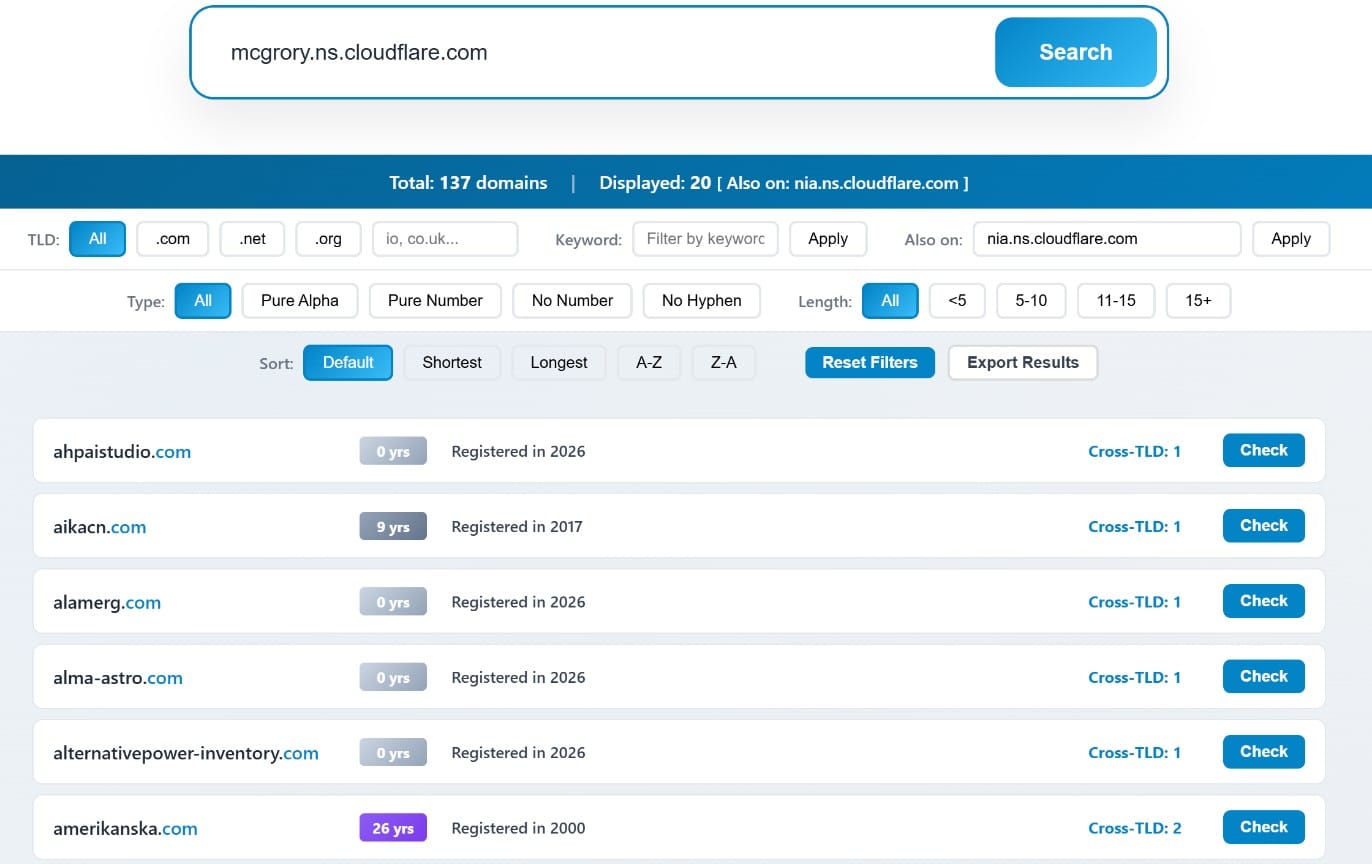
Suppose an incident team has received an email from newbooker.com and starts from that sender domain. Reverse NS takes either a nameserver hostname or a domain name directly. Entering newbooker.com resolves its primary nameserver (mcgrory.ns.cloudflare.com), lists the domains delegated to it, and displays the domain's other nameserver (nia.ns.cloudflare.com) above the results. That lookup on mcgrory.ns.cloudflare.com returns 87,557 domains. Pasting nia.ns.cloudflare.com into Also on keeps the domains delegated to both servers, cutting the list down to 137.
Cloudflare's nameserver documentation notes that Cloudflare favors assigning consistent nameserver names across the zones in a Cloudflare account, which is why narrowing to a pair tends to keep one operator's domains together. Zone conflicts within an account can still place a domain on another pair, and sharing two nameservers does not by itself show who holds a domain, so the pair's list serves as a shortlist to inspect rather than proof of a common operator.
Pivot to related domains and check their WHOIS and DNS
Entering planetmaison or reallifeaccounting in the Keyword filter brings up each row inside that shortlist, showing that the pair links newbooker.com to another sender and to the redirect destination despite the unrelated names. The fourth domain in the warning, moments-notice.com, does not appear in the results for this pair.
Each row in the results lists the domain's age, registration year, and Cross-TLD count (the number of extensions where that exact label is registered). The three warning domains on this pair are older registrations from 1999 and 2015 rather than newly registered 2026 names.
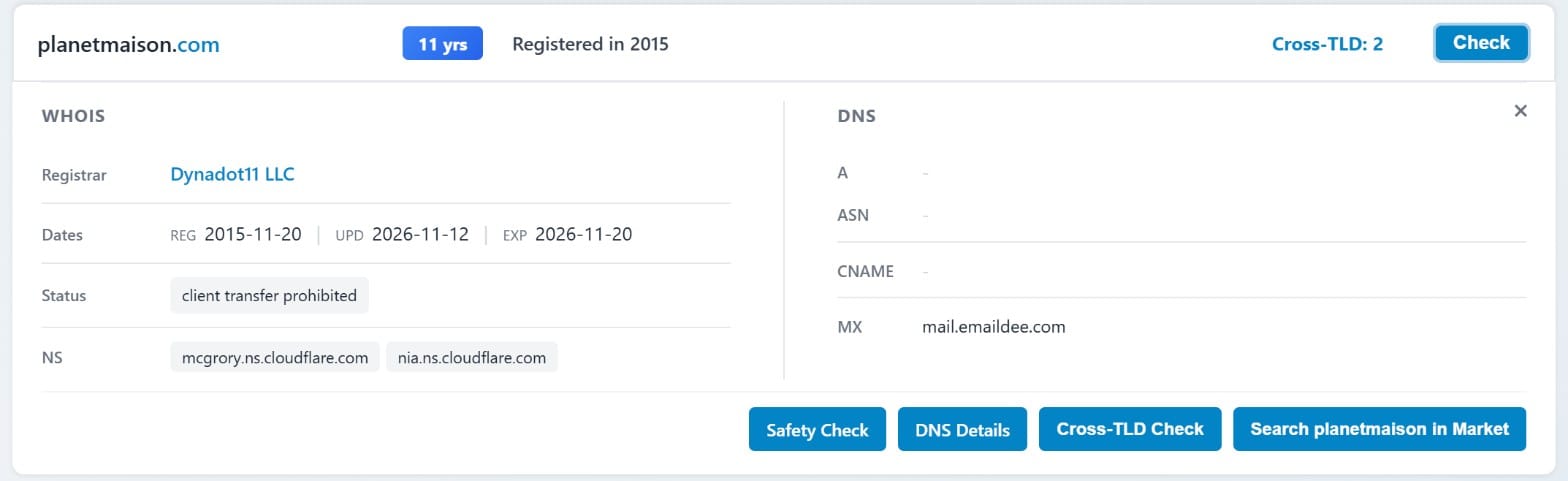
Clicking Check on a row opens its WHOIS and DNS records inside the list. Both planetmaison.com and newbooker.com have no A record and point their MX record to mail.emaildee.com, whereas reallifeaccounting.com has A records and no MX record. Their WHOIS records also show updates between 10 and 12 November 2026.
Filter by extension or keyword and export to CSV
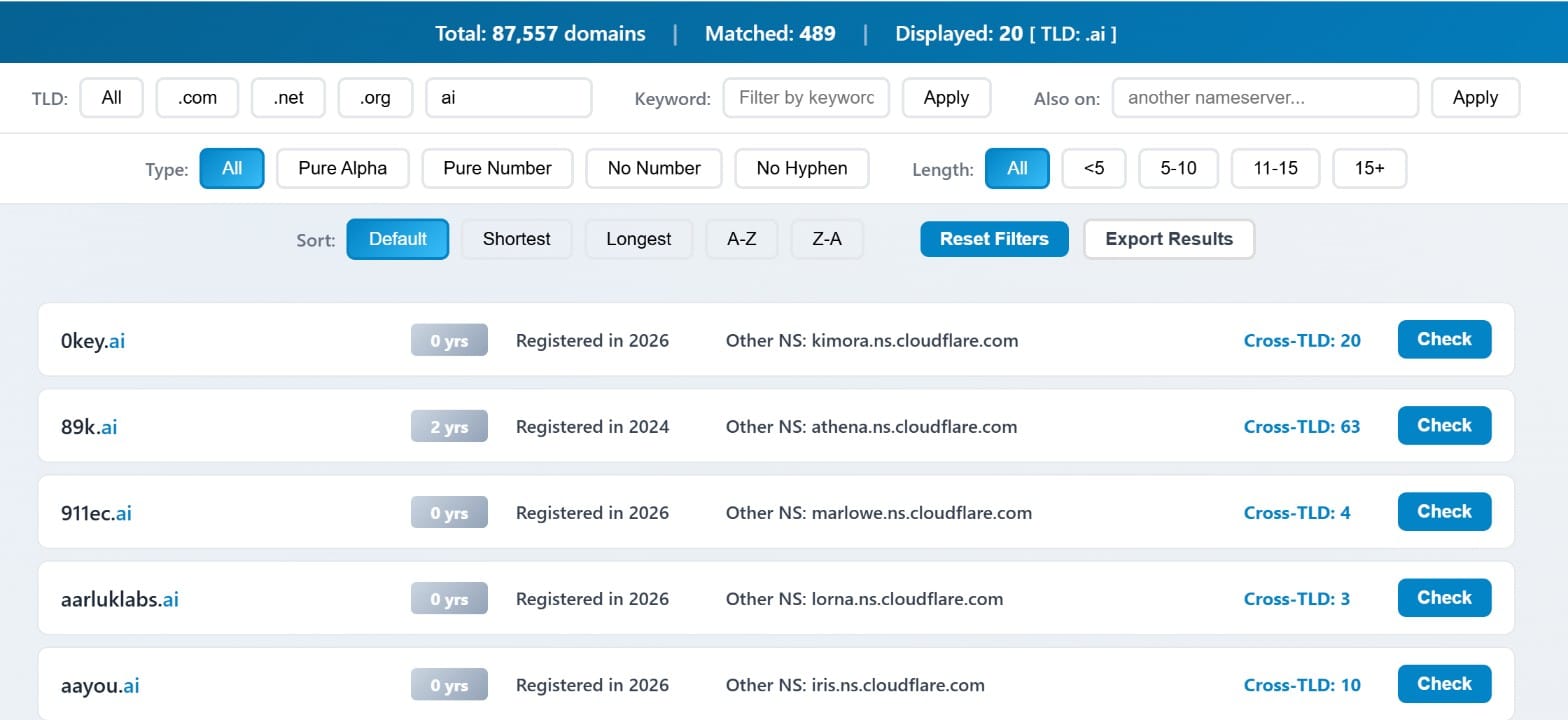
When a nameserver list is still broad, the controls above the results filter by extension, keyword, character type, and domain length, and sort alphabetically or by length. The extension filter accepts country-code TLDs alongside generic extensions. Filtering mcgrory.ns.cloudflare.com to .ai (entered as ai) leaves 489 domains, while filtering the pair to .com leaves 88. Export Results downloads the filtered list as a CSV file.
Summary
| Goal | How to do it in DomainKits |
|---|---|
| List domains on one nameserver | Enter the nameserver or a domain in Reverse NS |
| Isolate a shared nameserver pair | Add the second nameserver in Also on |
| Inspect WHOIS, A, and MX records | Click Check on the domain's row |
| Narrow or save a large list | Filter by TLD, keyword, type, or length, then click Export Results |
- Tool results: DomainKits Reverse NS on 16 November 2026. Counts change as domains move between nameservers.
- Phishing warning: GBHackers and Cyberpress, 16 November 2026, citing Microsoft Threat Intelligence. Registration dates, update dates, nameservers, and A and MX records of the named domains were checked against registry records and DNS on 16 November 2026.
- Coverage of DomainKits data: data overview.
Watch the video
Get new articles by email
No account needed. At most one email a day, only when there is something new.
We use your email only to send new articles. Every email has a one-click unsubscribe link. Privacy policy