New Websites List: What Domains and Services New Websites Actually Use
Table of contents
Using DomainKits data, we analyzed website building across 2,583,825 newly registered domains from 9 to 15 November 2026, checked on 27 November. After cleaning the data to filter out domains clearly not used for a website, such as placeholder, parked and for-sale pages, 18.7% (482,502) had a live website. Here is what that new websites list looks like in two layers: the domains these sites chose and the services they run on.
What TLDs do new websites use?
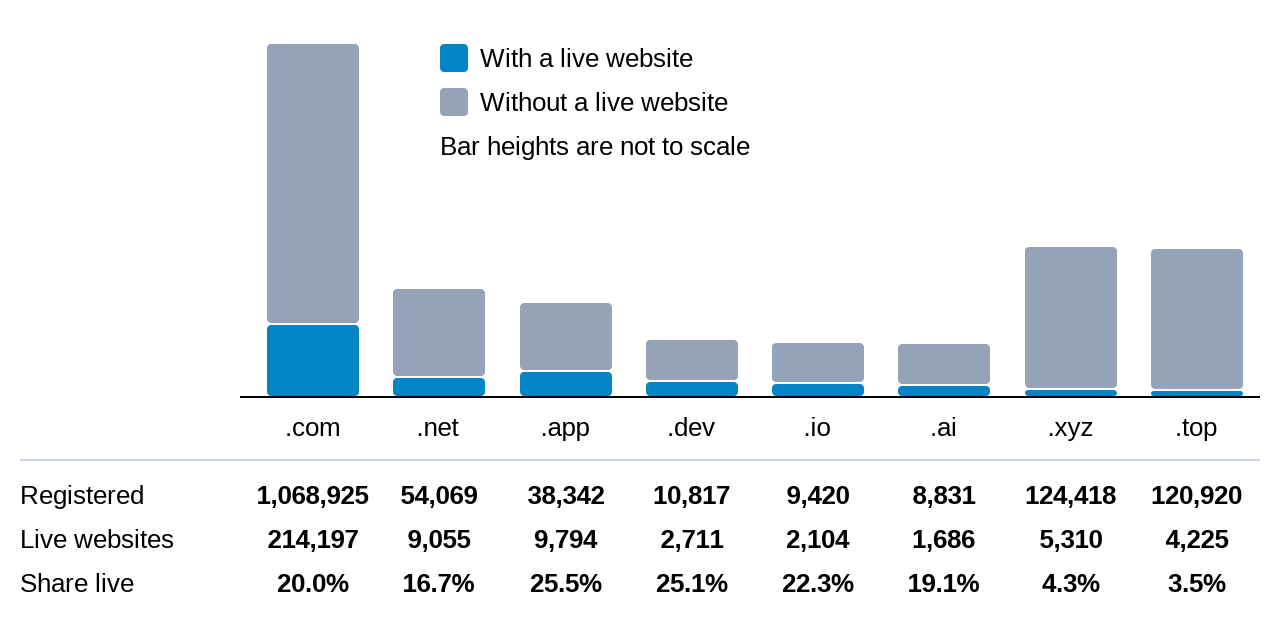
.com still accounts for by far the most newly registered domains, and about a fifth of them (20.0%) had a live website. Because many short, clear .com names are already held by established websites, domain investors and private collectors, newer gTLDs and country-code TLDs such as .app, .dev, .io and .ai have become common alternatives.
The names on those alternatives are noticeably shorter: on live websites under .app, .dev, .io and .ai, the name before the dot has a median of 8 characters (about half are 8 characters or fewer), compared with a median of 12 on .com (where only about a fifth are 8 or fewer). More TLD options let a new project launch on a short name without paying .com aftermarket prices. Higher registration fees on .io and .ai, along with required HTTPS on .app and .dev, also filter out casual and bulk registrations, helping lift the live share on .app (25.5%), .dev (25.1%) and .io (22.3%) above .com.
Low-cost, high-volume new gTLDs show the opposite effect: .xyz and .top frequently run low first-year promotions and rank near the top by registrations, yet fewer than one in twenty turned into a live website. On other major country-code TLDs, the live share is typically around 20% as well, with .de, .uk and .ca slightly above it and .fr higher at about a third.
What services do new websites use?
Email (MX) setup
An MX record tells other mail servers where to deliver a domain's email, showing which new websites already have mail routing in place. Of the week's live websites, 171,982 (35.6%) had one.
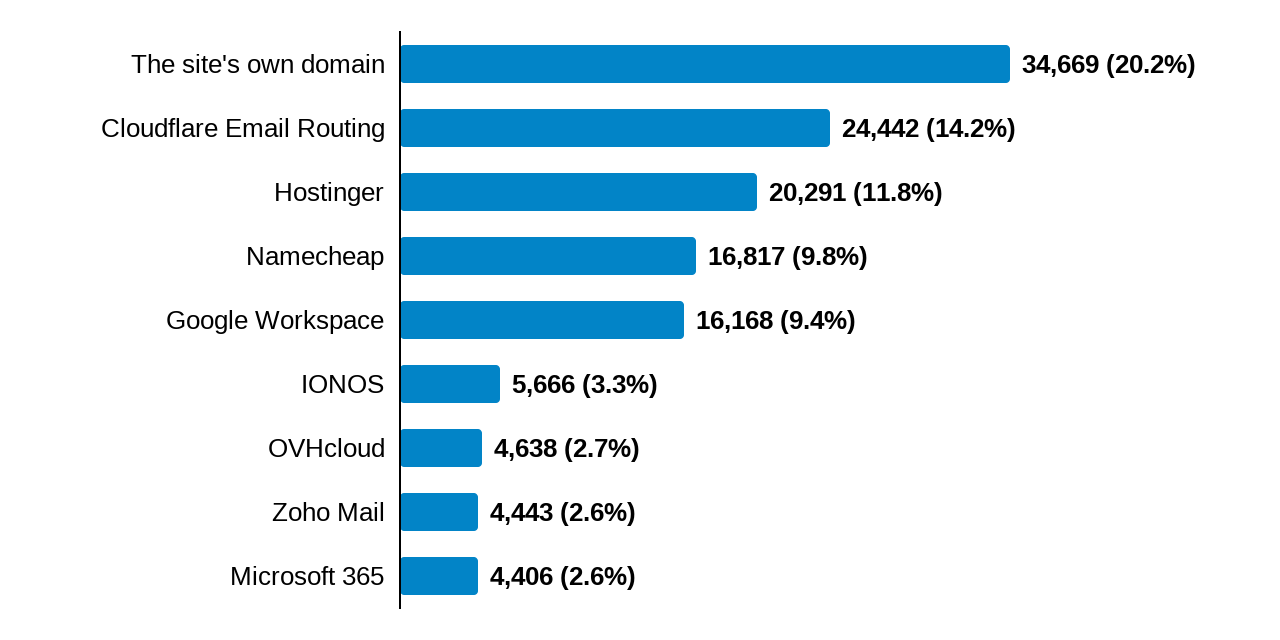
The largest group points mail to a host under the site's own domain (such as mail.example.com), a standard default in cPanel, Plesk and other shared hosting setups rather than a separate mail provider. Cloudflare Email Routing, which forwards mail to an existing inbox, is the largest named service, followed by Hostinger and Namecheap. Because registrars and web hosts often write default MX records automatically, while Google Workspace (9.4%) and Microsoft 365 (2.6%) require deliberate setup, the one in eight sites using those two office suites is a cleaner signal of an active business.
Infrastructure, CDN and hosting
Figure 3 measures the edge layer that directly answers for each site's homepage, whether as a reverse proxy, CDN or web host. On W3Techs, Cloudflare serves as the reverse proxy for 30.4% of websites (November 2026); among the week's newly launched websites, Cloudflare appears on 55.2% (266,153 sites), followed by Vercel (8.8%) and Hostinger (7.8%). Because reverse proxies such as Cloudflare sit in front of the origin server, Figure 3 reflects what answers at the edge rather than every underlying host.
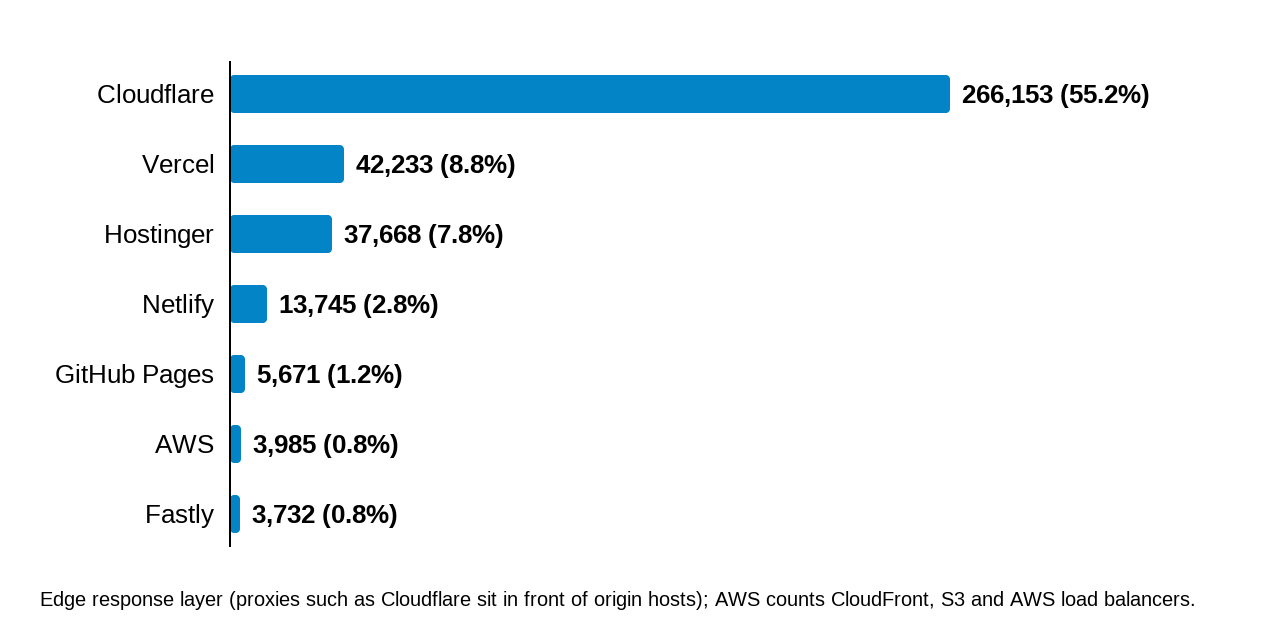
Many websites on newly registered domains are personal projects, early prototypes or small businesses that lean on low-cost stacks at launch. Cloudflare bundles DNS, CDN, SSL and email routing in one place, while Vercel lets developers deploy quickly, reaching 23.1% of live websites on .app and 24.7% on .dev. Traditional small-site hosts such as Hostinger remain widely used alongside them.
CMS and website builders
A CMS or website builder was identified on 78,151 of the week's live websites (16.2%). Another 70,832 (14.7%) without a CMS show modern frontend frameworks or build tools instead, led by Next.js (29,814), Vite (26,470) and Astro (11,051). That reflects how much of the new web is built as custom apps, static pages and AI-generated frontends rather than traditional CMS sites.
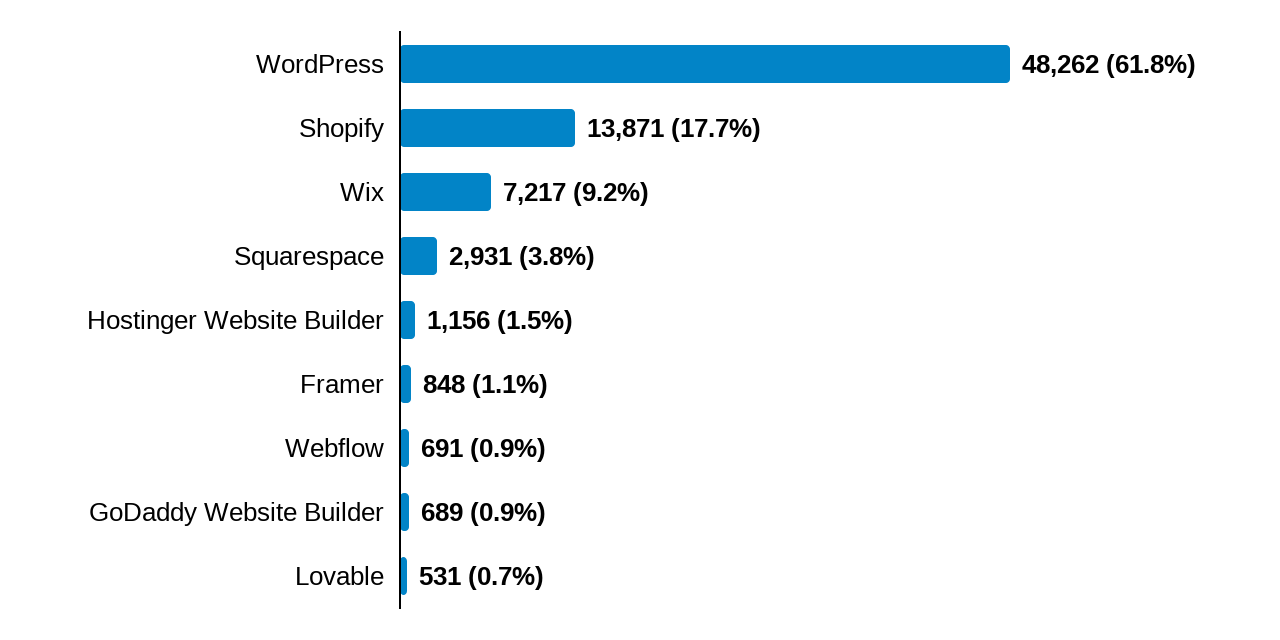
Among sites with an identified CMS, WordPress leads at 61.8%, close to its 57.3% share of known-CMS websites on W3Techs (27 November 2026). For traditional businesses, local services and smaller projects choosing a CMS, it remains the default way to get online quickly.
Within that CMS group, hosted builders and ecommerce take a much larger share at launch: Shopify sits at 17.7% against 8.2% on W3Techs, and Wix at 9.2% against 6.2%. These platforms are built to take a small project from zero to one without server or payment setup, and on shopping TLDs Shopify overtakes WordPress outright: 1,717 to 1,075 on .shop and 1,179 to 692 on .store.
Summary
Raw domain registrations and real website launches tell two different stories. Fewer than one in five newly registered domains became a live website within just over two weeks of registration, and high-volume TLDs like .xyz and .top drop sharply once parked and placeholder pages are filtered out.
Among the sites that actually launch, getting from zero to one with minimal friction shapes the entire stack: shorter names on .app, .dev, .io and .ai where .com is crowded, low-cost infrastructure led by Cloudflare and Vercel, and a split across WordPress, hosted launch platforms like Shopify and Wix, and modern JS frameworks. Tracking which newly registered domains go live, set up business email and adopt a platform gives a far cleaner signal of real new projects than registration counts alone.
Find these sites on the New Website List
The DomainKits New Website List follows newly registered domains for 60 days and lists the ones that have turned into live websites. Search it by title and description, filter by TLD, MX, platform, language and payments, and try a search of your own.
- Data: DomainKits sample of domains registered 9 to 15 November 2026, observed 27 November 2026. Figures reflect this snapshot and change over time.
- Live websites exclude parked, for-sale and placeholder pages.
- Within each chart, a site with more than one provider counts under each; WordPress plugins such as Elementor, WooCommerce and Divi are not counted as separate CMS.
- Figure 3 reflects the edge response layer (proxies such as Cloudflare sit in front of origin hosts); AWS counts CloudFront, S3 and AWS load balancers.
- External figures: W3Techs (27 November 2026).
- Coverage: data overview.
Get new articles by email
No account needed. At most one email a day, only when there is something new.
We use your email only to send new articles. Every email has a one-click unsubscribe link. Privacy policy