Newly Registered Domains Live: A 15 to 20 Minute Index for Brand Protection
Newly registered domain data is usually published on a daily cycle. A domain registered Monday morning generally appears in a list on Tuesday. For most work that is fine. For brand protection it is the gap worth closing, because every action you might take starts only once you know the domain exists.
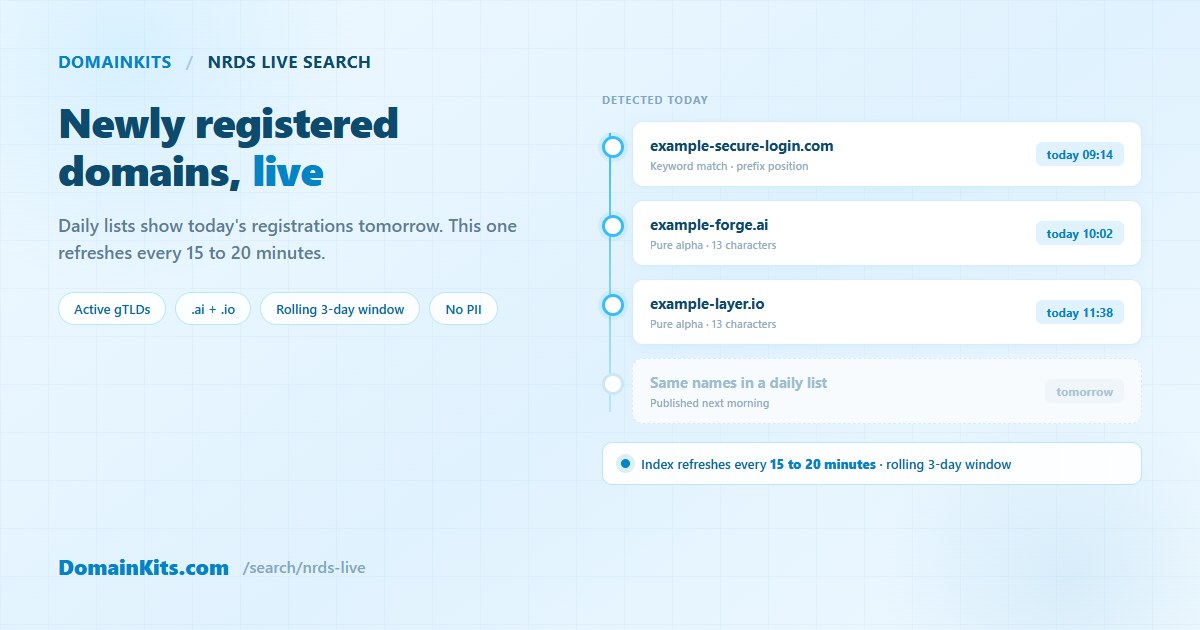
Update, September 6, 2026: the live stream described here used to have its own page at /search/nrds-live. It has since merged into the new domain search, where signed-in members reach it with the Live filter set to Yes. The old address redirects there. Nothing about the stream itself changed, so everything below still applies; only the way in is different.
The live stream refreshes its index every 15 to 20 minutes, and in most cases a registration becomes searchable the same day it happens. For a brand team that is the difference between opening a case during today's business hours and opening it during tomorrow's.
The stream trades breadth for timing. It does not hold more domains than the daily-list approach and it does not reach further back. It is narrower and earlier, and the sections below cover both halves of that.
Why daily lists of newly registered domains arrive late
Most newly registered domain data is distributed as a daily file. The underlying comparison runs on a fixed schedule, and the resulting list of new names goes out as a download once that cycle completes. The approach works and the coverage is thorough, but it carries a structural delay: a domain registered at 09:00 on Monday appears in a list published sometime Tuesday.
For most use cases that delay does not matter. Domain investors reviewing registration patterns do not need hourly resolution. Researchers studying naming trends do not either.
Brand protection is where it matters, and the reason is structural rather than dramatic. Noticing a lookalike registration is not the response, it is the trigger for one. What follows takes time of its own: confirming the domain is actually a concern, checking where it resolves, filing with the registrar or a takedown service, getting it into internal blocklists, telling the people who need to know. Every one of those steps has a queue and a business-day rhythm.
Detection time sits in front of all of it. Shortening it does not just save those hours, it moves the entire chain a day earlier. A domain surfaced at 10 AM can be assessed and filed the same afternoon. The same domain surfaced in tomorrow's list is assessed tomorrow, filed tomorrow, and in front of the registrar a day later.
That is the case for a live index, and it is specific to this use case. It does not make the data more complete, and it does not help if nobody is watching the results.
What the live index is
The live stream does not wait for a daily cycle. It refreshes every 15 to 20 minutes and holds a rolling 3-day window of recent registrations.
Worth being precise about that number: it is the refresh cadence of the index, not a promise about how quickly any individual registration shows up. Some names appear soon after they are registered. Others take longer.
The method favors timing over exhaustiveness. It covers the active portion of newly registered domains, and names that stay dormant may surface later or not at all. For coverage that does not depend on activity, the new domain search is the better tool.
Coverage: active gTLDs plus .ai and .io
The live stream covers active generic top-level domains, plus two country-code extensions that behave like generic ones in practice: .ai and .io.
Both are technically country-code extensions, .ai assigned to Anguilla and .io to the British Indian Ocean Territory. In practice neither works that way anymore. They are registered from all over the world and used as public-facing front doors for products meant for a global audience: .ai has become the default extension for artificial intelligence companies, and .io has been a developer and startup staple for over a decade. A name in either one is a global portal, not a marker of two small territories. Registration volume in both is high enough, and commercial enough, that leaving them out would put an obvious hole in the coverage.
Why common ccTLDs are excluded
Most country-code extensions are not in scope, and the reason is data protection rather than technical difficulty.
A generic extension carries no geographic signal. Knowing that example.com was registered tells you nothing about where the registrant sits. Many national extensions are different: they are marketed to, and largely registered from, one country, and several restrict registration to applicants with a local presence. That is what makes the geographic correlation real. A stream of newly registered national ccTLD names, timestamped and aggregated, sits closer to a location-linked dataset than a generic-extension stream does.
Under GDPR, personal data is any information relating to an identifiable natural person, and the threshold for "identifiable" includes indirect identification by combining data. A domain name on its own is usually not personal data. A domain name plus a strong country signal plus a precise registration timestamp moves toward that line, particularly for individual registrants rather than companies.
The same test is what puts .ai and .io on the other side of it. Neither restricts registration by location, and neither draws its registrant base from the territory it was assigned to, so a registration in either carries no meaningful country signal. The geographic correlation that creates the concern for national extensions simply is not there.
The product principle predates this feature and settles the rest: DomainKits tracks what happens to domains, not who owns them. Restricting live coverage to generic extensions plus .ai and .io keeps the dataset firmly on the "what" side. No registrant names, no addresses, no contact records, and no extension set that acts as a proxy for them.
If you need broader extension coverage, the new domain search operates on a different basis with wider gTLD reach and a 60-day window.
Three ways to search
The new domain search offers three modes, selected by the toggle under the search box. All three respect the Live filter.
Keyword
Enter a brand, a product term, or any string, and the search returns newly registered domains containing it. This is the mode most brand protection work uses. Search your brand name and check the results each morning; anything unexpected is worth a look.
Keyword mode adds two filters the other modes do not have:
- TLD: restrict to .com, .net, .org, or type any extension into the find box.
- Position: where the keyword sits in the name. Start catches
yourbrand-login.com, End catchessecure-yourbrand.com, Middle catches the rest.
Browse by TLD
Enter an extension and see every recent registration under it. Useful for watching a specific namespace: a new gTLD you are tracking, or .ai during a period of heavy activity. Once inside a TLD you can still filter down with a keyword search.
Browse All
Open the full index with no keyword and no extension filter. This is the mode for pattern watching rather than targeted lookup. Sort by newest and scroll, or apply length and type filters to isolate a shape of name.
Filters
All three modes share a common filter set. The ones that matter most for brand work:
- Live: Yes for the 15 to 20 minute stream, No for the 60-day daily index. On by default for signed-in members.
- Registered: narrows to how recently a name was registered. With Live on, the window is the rolling 3 days.
- Type: Pure Alpha, Pure Number, No Number, No Hyphen. Hyphens and digits are common in bulk and throwaway registrations, so excluding them sharpens a list quickly.
- Length: under 5, 5 to 10, 11 to 15, over 15 characters.
- Exclude: a comma-separated list of substrings to drop. Filtering out
test,demo, andtmpremoves a lot of noise. - Sort: Newest, Oldest, Shortest, Longest.
Each result row shows the domain, how long ago it was registered, the name components, creation date, registration period, and a cross-TLD count. The Check button opens inline actions: safety check, DNS details, cross-TLD lookup, and jumps into the new and active domain searches for the same keyword.
The Live filter
Two things feed the new domain search. The daily update carries broad gTLD coverage across a rolling 60-day window. The live stream carries the past three days, refreshed every 15 to 20 minutes, across active gTLDs plus .ai and .io. The Live filter decides which of them you are looking at.
| Live: Yes | Live: No | |
|---|---|---|
| Refresh | Every 15 to 20 minutes | Daily |
| Window | Rolling 3 days | Rolling 60 days |
| Coverage | Active gTLDs, .ai, .io | Broad gTLD coverage |
| Dormant names | May take longer to surface | Not dependent on activity |
| Best for | Early warning | Depth and history |
Signed-in members get Live set to Yes by default. Use it for the alert, then switch it off for the investigation that follows: same keyword, same page, sixty days of history instead of three.
Having both behind one toggle is the practical gain from the merge. The two used to be separate pages, which meant re-running the search on the other one to widen the window.
A practical brand protection routine
The setup takes about five minutes and costs a couple of minutes a day after that.
- Search your brand name in keyword mode on the new domain search, with Live set to Yes. Set Position to All so you catch prefixes and suffixes.
- Add your common misspellings as separate searches. If your brand is
acme, also runacrne,acmee, andakme. - Set Registered to Today and sort by Newest.
- Exclude the substrings that generate noise for you.
- On anything suspicious, hit Check and run a safety check and DNS lookup without leaving the page.
For systematic permutation coverage rather than manual guessing, the typosquat scanner generates and checks the full permutation set in one pass. And for anything you already own, Domain Monitor watches for registrar, nameserver, DNS, and status changes on an hourly cycle.
What the data is, and is not
Two limits worth being explicit about.
It is not exhaustive. Coverage is strongest for names that go live soon after registration and weakest for names registered and left dormant.
It is a snapshot, not a status check. Each entry records what was observed at observation time. A domain listed here may since have changed configuration, changed hands, or been dropped. For the current state of a specific name, run a WHOIS lookup.
Get started
Newly registered domains live, searchable now. No download, no list to process, no waiting until tomorrow.
- Open the new domain search, with the Live filter on
- Typosquat scanner
- Plans and filter access
Scope note: the live stream does not represent all newly registered domains. It covers the active portion of them, the names that go live soon after they are registered. Names that stay dormant may surface later, or not at all. For coverage that does not depend on activity, set the Live filter to No and search the full 60-day index instead.