.app and .dev Growth: A Window into AI-Era Entrepreneurship
In the year to September 6, 2026, DomainKits recorded a net increase of 741,234 .app domains and 241,410 .dev domains. Together, the two extensions added nearly a million domains to their active inventory. Over the same dates, .net added 98,836.
That growth raises a question: what is being built under these names? AI tools now connect software creation, publishing and domain registration in the same workflow. Their use by people starting products and side businesses offers a plausible explanation for part of the activity, and a reason to look more closely at recent registrations.
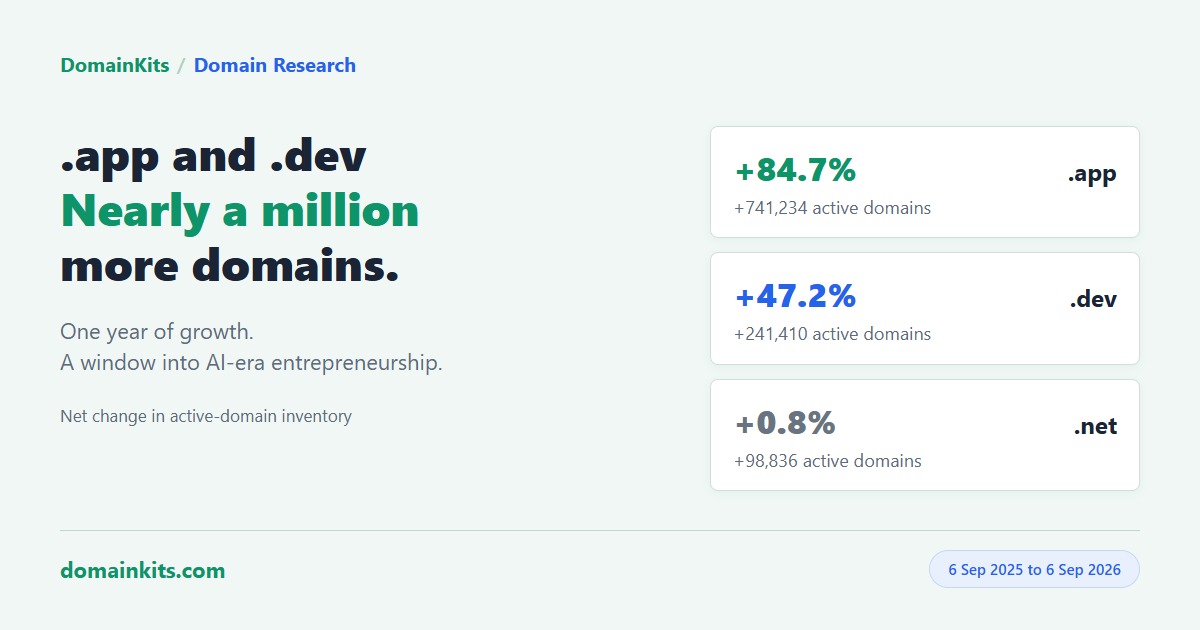
A year of growth, with .net for comparison
The same two dates show how differently the three extensions grew:
| Extension | September 6, 2025 | September 6, 2026 | Net increase | Growth |
|---|---|---|---|---|
| .app | 875,270 | 1,616,504 | 741,234 | 84.7% |
| .dev | 511,418 | 752,828 | 241,410 | 47.2% |
| .net | 12,286,378 | 12,385,214 | 98,836 | 0.8% |
.net remains much larger, with more than 12 million active domains. But .app and .dev each added more domains in absolute terms, as well as growing faster from smaller bases. Their combined net increase was 982,644. These newer naming spaces are expanding; the comparison does not imply that registrations moved from .net.
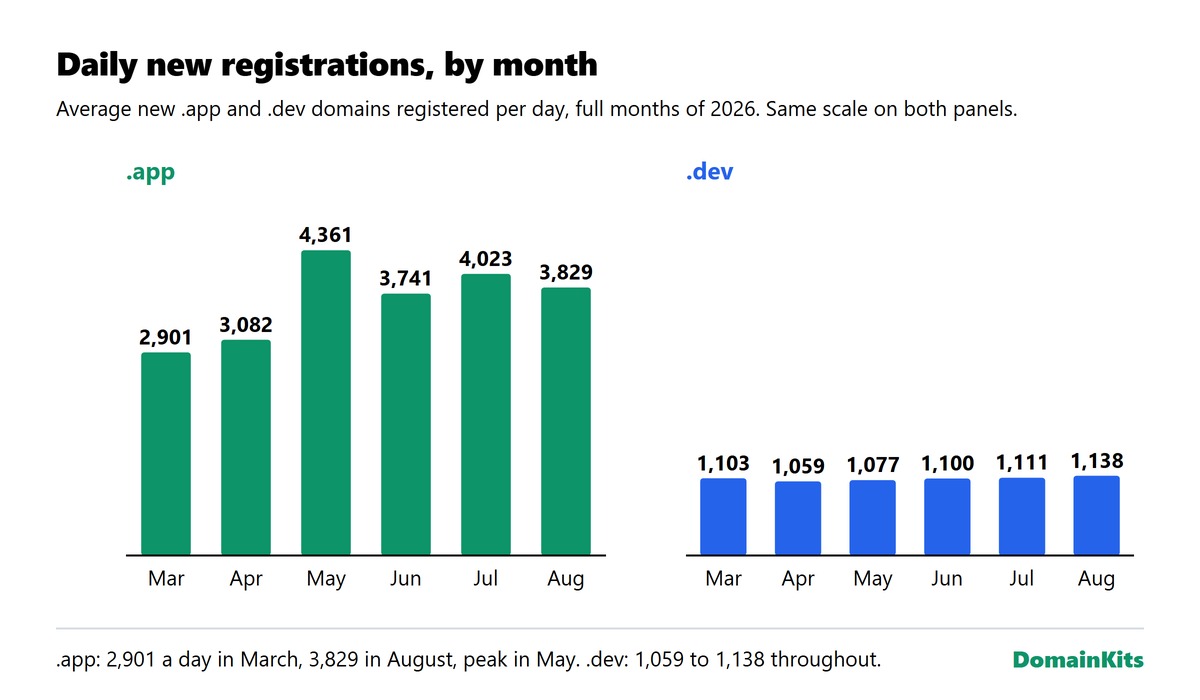
Recent registration volumes differ between the two. Daily .app registrations averaged 2,901 in March 2026 and 3,829 in August, up 32.0%, though below May's 4,361. .dev was steadier: 1,103 a day in March and 1,138 in August, up 3.1%.
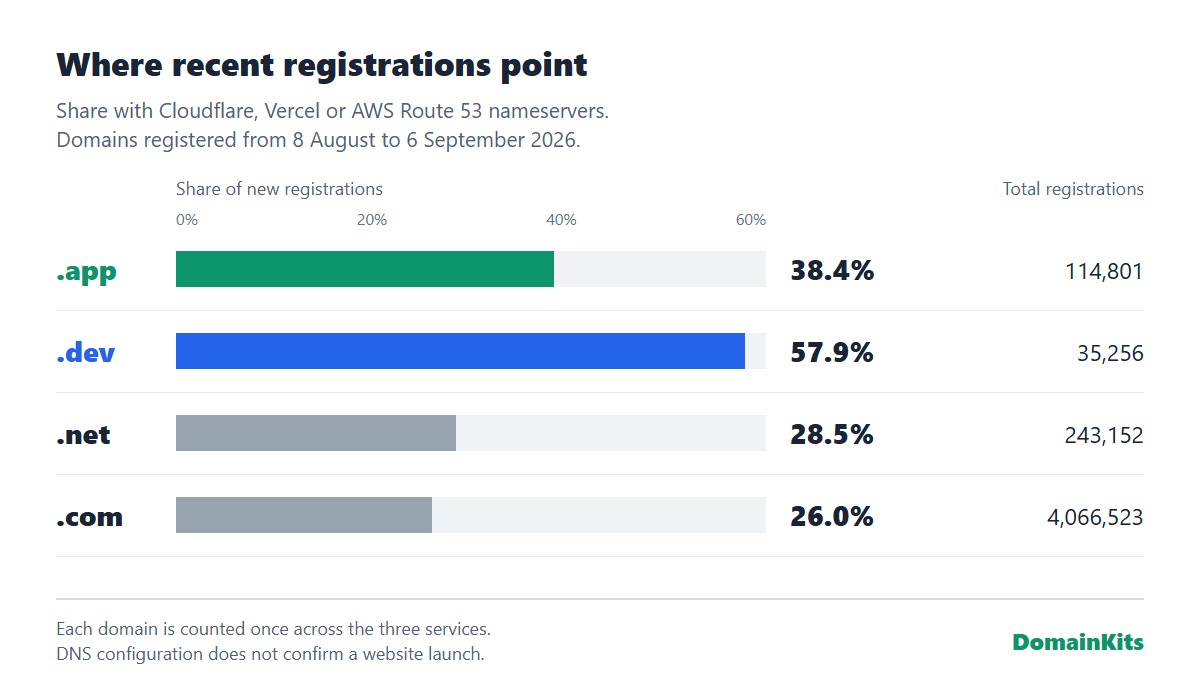
Where the latest 150,057 registrations point
From August 8 to September 6, 2026, DomainKits recorded 114,801 newly registered .app domains and 35,256 newly registered .dev domains. Their nameservers give an initial view of the services chosen for these names:
| Provider | .app | Share | .dev | Share |
|---|---|---|---|---|
| Cloudflare | 36,907 | 32.1% | 17,284 | 49.0% |
| Vercel | 5,594 | 4.9% | 2,137 | 6.1% |
| AWS Route 53 | 1,593 | 1.4% | 1,006 | 2.9% |
| At least one of the three | 44,093 | 38.4% | 20,425 | 57.9% |
For comparison, the combined share was 28.5% among 243,152 new .net domains and 26.0% among 4,066,523 new .com domains. Counting only Vercel and Route 53, the shares were 6.26% of .app and 8.91% of .dev, against 1.34% of .net and 1.70% of .com. New .app and .dev registrations were more concentrated on these services than either legacy extension.
Cloudflare's registration channel is worth noting. It accounted for 20,382 .app and 11,915 .dev registrations, spread across every day of the 30-day period. Cloudflare Registrar requires its own DNS, so choosing the registrar also means choosing that DNS service. The daily spread supports a reading of sustained demand to use Cloudflare, rather than a single day's registration burst.
AI shortens the path to a first product
AI offers a plausible explanation for some of this demand because it reduces the work between an idea and a first version people can try. It also brings domain registration closer to the act of building.
In its August 2025 announcement of v0.app, Vercel described a tool that generates interfaces, content, backend code and application logic, with founders using it to build early products. Lovable lets a builder buy a domain from a project's publishing workflow and connect it to the project. A first version and its public address can now be set up within the same tool.
The registration records contain a related connection: Name.com accounted for 4,980 of the 5,594 .app domains with Vercel nameservers, and 1,878 of the 2,137 .dev domains. Vercel's domain terms name Name.com and Tucows as registration providers. That integration may help explain the concentration, although the records do not identify the checkout used for each purchase.
There is also industry-level evidence outside this dataset. A chart reproduced on page 34 of MUFG's February 2026 report on AI in the real economy, taken from the Financial Times article "The AI Shift: Is this the 'take off' moment for AI agents?" of February 5, 2026, shows year-on-year growth in new websites reaching 35% in data through August 2025. The chart's sources include the Domain Name Industry Brief, so the series tracks new names and sites being created rather than a count of working websites. It is consistent with the growth recorded here without measuring the same thing.
More room for individual entrepreneurship
Read alongside those changes in how software is made, the growth of .app and .dev is a possible signal of a broader wave of individual and small-team entrepreneurship. The relevant activity includes modest attempts: a niche service, a small paid tool, or a side project being prepared for its first users.
When one person can build a first version with AI assistance, they can test an idea before assembling a larger team. Registering a domain gives that attempt a name and an address to share. The product still needs customers, but less work may be needed before finding out whether anyone wants it.
This makes domain activity useful to observe. For an AI-built project, registering and configuring its own domain is a step toward presenting it to people beyond the building tool. Following the domain over time can help distinguish an initial experiment from a product that stays in use.
What success looks like for new TLDs
The growth also matters for .app and .dev as extensions. They already serve as the primary addresses of established products and projects: the Go language at go.dev, React documentation at react.dev, Cash App and Linear. Those sites predate the registration window, but they show uses beyond holding a name for resale.
The AI builders themselves use these extensions. Lovable operates at lovable.dev, while Vercel changed v0.dev to v0.app in August 2025 as it described a broader audience for the product. These extensions form part of the products' public identities.
Growing registration inventory alongside visible product use is evidence of adoption for these two new TLDs. Their success does not require replacing .com or .net: they can become established choices for particular kinds of work. The figures here support that narrower story, not a claim that every new extension is succeeding.
An early way to observe AI adoption
Domain registrations offer a way to study AI's effects beyond model benchmarks, funding announcements and activity inside coding tools. If AI is helping more people start products, one place to look for the result is the names they register and what later appears at those addresses.
The next step would be to follow a sample of these registrations: which develop product pages, which remain in use after 30 or 90 days, and which are renewed a year later. Reviewing public sites could separate products from sale pages and unused names. That would add evidence about what lasts after the initial attempt to build.
The year-on-year growth makes .app and .dev worth watching. The 150,057 recent registrations give us a group to follow from registration through use and renewal, and a way to investigate whether easier software creation is leading to more lasting products.
This piece stops at DNS. The 150,057 registrations behind it can be pulled from DomainKits' newly registered domains search, with nameservers, registrar and registration term for each name, for anyone who wants to take the analysis further. Researchers and students working on related questions are welcome to contact us for a free research account.
Data and scope
Annual figures compare DomainKits' recorded active-domain inventory on September 6, 2025 and September 6, 2026. They are net changes, not gross registration totals or counts of working websites. Monthly daily averages use full calendar months from March to August 2026. The recent registration sample covers August 8 to September 6, 2026, inclusive.
DNS counts match nameservers under cloudflare.com, vercel-dns.com and the AWS awsdns service-domain families, ignoring case and trailing dots. Combined counts include a domain once if any nameserver matches; one .app and two .dev records match more than one provider. Percentages use all registrations in each extension, including records without nameservers. Registrar name variants are combined.
Nameservers describe DNS configuration, not necessarily the application host or a live website. Registrar defaults can supply these records, and applications can also use A or CNAME records without changing nameservers. The dataset does not identify AI use, the number of founders, revenue or when a DNS configuration was first applied. The interpretation above combines domain observations with external evidence about AI building tools; it does not assign a share of growth to AI or treat one domain as one business. Website and persistence checks were not performed. They would be informative, but they fall outside the scope of this piece.
Get new articles by email
No account needed. At most one email a day, only when there is something new.
We use your email only to send new articles. Every email has a one-click unsubscribe link. Privacy policy