How Many TLDs Are There? Before New gTLDs, Now, and the 2026 Round
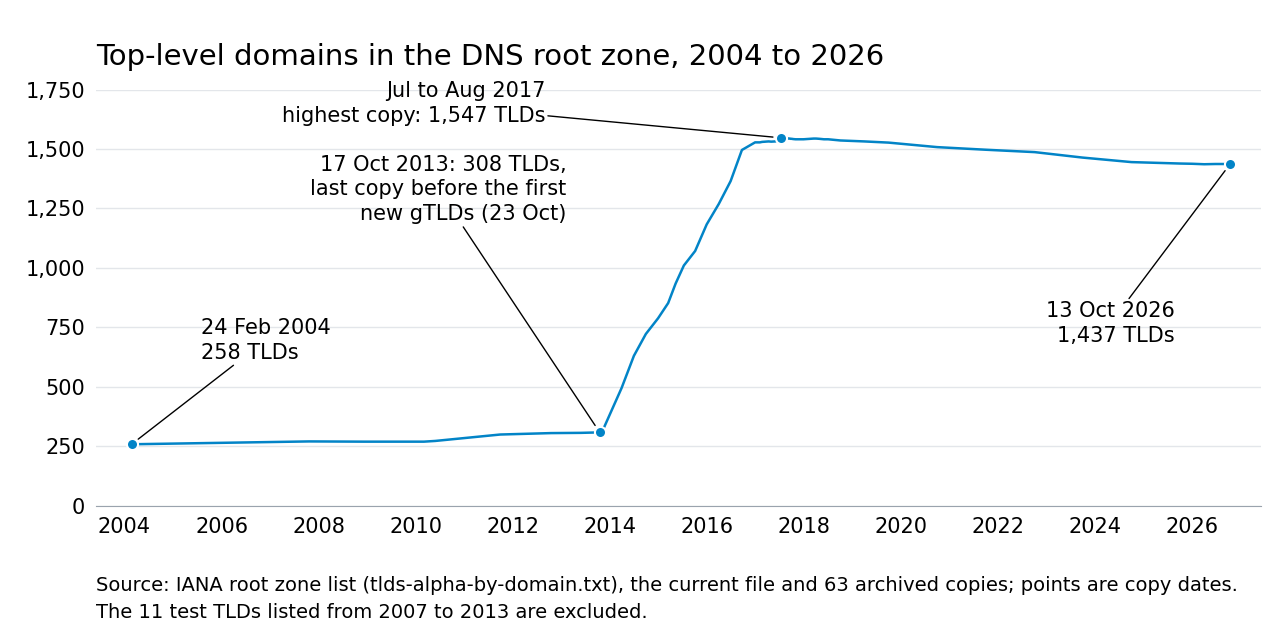
IANA lists 1,437 top-level domains in the DNS root zone as of 13 October 2026. Before the 2012 round, there were only a few hundred, most of them country codes. The new gTLDs took the count to 1,547 by the summer of 2017. Since then, it has fallen, largely as brand TLDs were retired.
Another round is now under way. ICANN published 1,615 applications on 7 October 2026, including competing bids for .agent from OpenAI, Google and Meta.
How many TLDs are there today
IANA sorts the 1,437 TLDs into five types. The table shows each type in today's root zone.
| Type | TLDs | What it holds |
|---|---|---|
| Generic | 1,110 | .com, .net, .org, .info, .mobi and the TLDs of the 2012 round, from .app to .zone; 90 of them are internationalized strings such as .在线 and .онлайн |
| Country code | 309 | 248 two-letter codes, nearly all taken from ISO 3166 (.eu for the European Union and .uk are among the exceptions), plus 61 internationalized codes such as .рф and .中国; a country can hold several |
| Sponsored | 14 | .aero, .asia, .cat, .coop, .edu, .gov, .int, .jobs, .mil, .museum, .post, .tel, .travel, .xxx |
| Generic-restricted | 3 | .biz, .name, .pro |
| Infrastructure | 1 | .arpa |
| Total | 1,437 | 151 of them are internationalized (IDN) TLDs, names that contain characters outside ASCII |
Counted the way ICANN counts, with the sponsored and restricted strings included, that is 1,127 generic TLDs, listed by IANA under 504 sponsoring organization names, plus 309 country codes and .arpa. DomainKits maps the 1,127 by the registry that operates them on its gTLD galaxy.
Before new gTLDs: the first top-level domains
The root zone began as a short list. RFC 920, published in October 1984, set out five generic categories, .com, .org, .edu, .gov and .mil, and a rule that each country would get its two-letter code from ISO 3166; .net followed in 1985 and .int in 1988. On 15 March 1985 symbolics.com became the first .com name. For the next two decades the list grew the way the map did: by February 2004 it held 258 TLDs, and 243 of them were country codes. ICANN's rounds of 2000 and 2004 added only a handful of generic names, such as .info, .biz and .mobi, and in October 2012 the generic side still stood at 22.
The map also took names away, slowly. Zaire's .zr was deleted in 2001, four years after the country became the Democratic Republic of the Congo and moved to .cd. Yugoslavia's .yu lasted until 2010, after Serbia and Montenegro had received .rs and .me in 2007. The Soviet Union's .su went the other way: it is still in the root, more than thirty years after the country dissolved, though its operator has been notified of a planned phase-out by 2030.
The last growth before the new gTLDs came from the countries again, this time in their own scripts. On 5 May 2010 the first internationalized country codes went live, in Arabic script for Egypt, Saudi Arabia and the United Arab Emirates, and Russia's Cyrillic .рф followed a week later; by October 2013 there were 36 of them. On the eve of the new gTLDs the root held 308 top-level domains, and 285 of them belonged to countries.
New gTLDs: the 2012 round
The 2012 round changed the scale of the list. ICANN received 1,930 applications for 1,409 different strings; at the outset, 751 of the applications competed for the same 230 strings. The first four new gTLDs entered the root on 23 October 2013, and all four were IDN strings: شبكة (Arabic for web), онлайн and сайт (Russian for online and site) and 游戏 (Chinese for game). The 11 test TLDs were retired on 31 October, and the copy of 5 November 2013 has 312 entries.
Then the delegations came in a stream, and by the summer of 2017 the list reached 1,547, the highest count in our copies.
Over more than a decade of promotion by their registries, the new names have found their uses. App makers took to .app, which holds about 1.7 million active domains today by DomainKits' count, and developers to .dev, with about 790,000. .lol, pitched at jokes and memes, has nearly doubled since April to about 1.1 million, and in August a viral site on it, outbid.lol, set off a wave of registrations. New gTLDs keep turning up in new trades and communities, and the Internet has grown more varied for it. But not every name lasted: since 2017 the list has been shrinking, mostly as brand TLDs were removed. Among them are McDonald's .mcdonalds and .mcd, and Fiat Chrysler's .chrysler, .dodge and .alfaromeo; its .jeep is still in the root.
Newest TLDs: the ICANN new gTLD program 2026 round
The next set of TLDs is already on the table. ICANN's 2026 round took applications from 30 April to 12 August 2026, at a fee of USD 227,000 each. 1,663 applications were submitted and 1,616 paid the fee; on Reveal Day, 7 October 2026, ICANN published 1,615 of them, from 481 applicants. 333 are brand applications, 21 are IDN strings, 16 are community applications and 15 are geographic names; 51 came through the Applicant Support Program. By region, 864 came from North America, 506 from Europe, 218 from Asia, Australia and the Pacific, 16 from Africa and 11 from Latin America and the Caribbean.
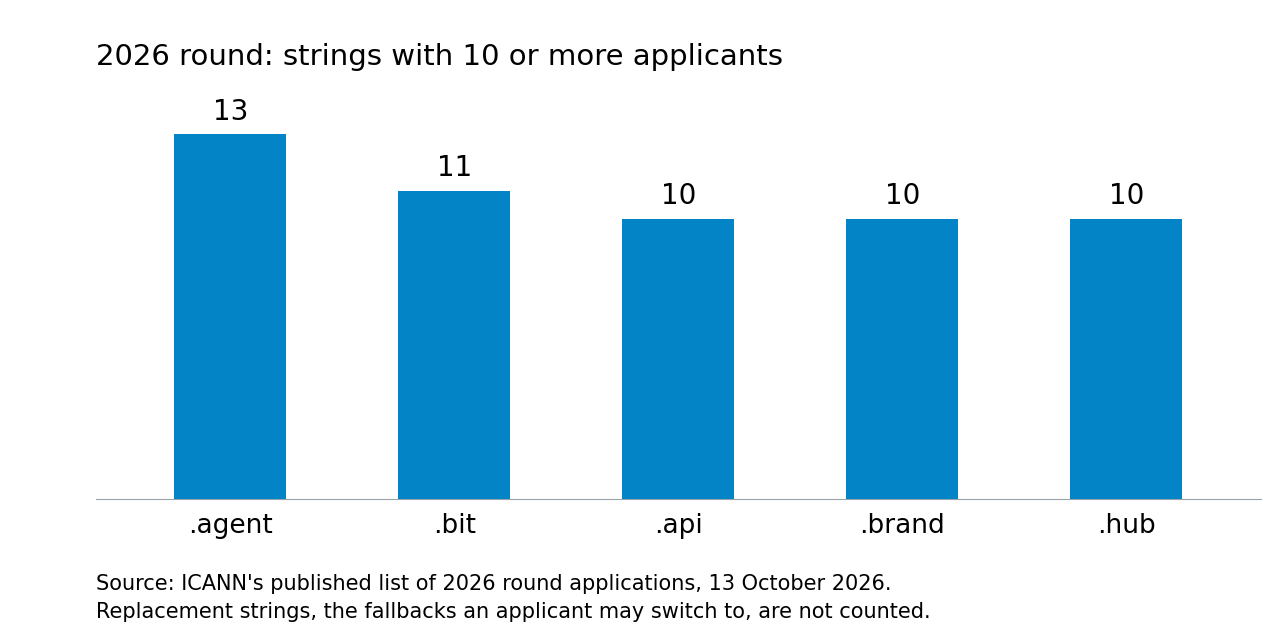
Five strings drew 10 or more applicants each. The most wanted is .agent, and OpenAI, Google and Meta are among its applicants. The same few registry companies turn up in nearly all five contests: XYZ.COM applied for every one of these strings, and Radix, Link Freedom Group and GoDaddy's Registry Services for four each. They are also among the biggest filers of the round. Link Freedom Group, a new company built on Nova Registry, the operator of .link, filed 158 applications, XYZ.COM 139 and Registry Services 77, most of them for strings that others want too.
Summary
Before the 2012 round, the root held a few hundred names, most of them country codes. It now holds more than a thousand, and new gTLDs such as .app, .dev and .lol together account for millions of domains.
In the 2026 round, .agent has drawn more applications than any other string, with OpenAI, Google and Meta among the applicants. Which of the new names reach the root, and when, is still to be settled.
- Root zone counts come from IANA's TLD list, current and archived copies, without the 11 test TLDs of 2007 to 2013. TLD types come from the IANA root zone database.
- 2012 round figures are ICANN's program statistics as of 31 August 2026, and registry agreement data is ICANN's list as of 13 October 2026.
- 2026 round figures come from ICANN's Reveal Day announcement. Counts per string and per applicant are our tally of ICANN's application list on 13 October 2026.
- Active domain counts by TLD, as DomainKits observes them, are on the Data Overview page.
Get new articles by email
No account needed. At most one email a day, only when there is something new.
We use your email only to send new articles. Every email has a one-click unsubscribe link. Privacy policy