What Happened to 459 .lol Domains After the Outbid Wave
Laugh out loud. "lol" is one of the oldest pieces of shorthand the internet still uses, and one of the few that outlived the systems it was born on. A Canadian bulletin board user, Wayne Pearson, has said he coined it in the mid 1980s, though no record of that first use survives. The earliest documented appearance is in the May 1989 FidoNews archive, after which it spread through Usenet, and by 2011 it had reached the Oxford English Dictionary as an interjection marking a joke.
The domain extension arrived much later. .lol was delegated to the DNS root in 2015 under ICANN's new gTLD program, one of hundreds of suffixes created to give the web somewhere to go beyond .com. Its registry positioned it around comedy, memes, and projects that want a light tone. The current operator, XYZ.COM LLC, markets the namespace through a site branded as the .LOL Registry.
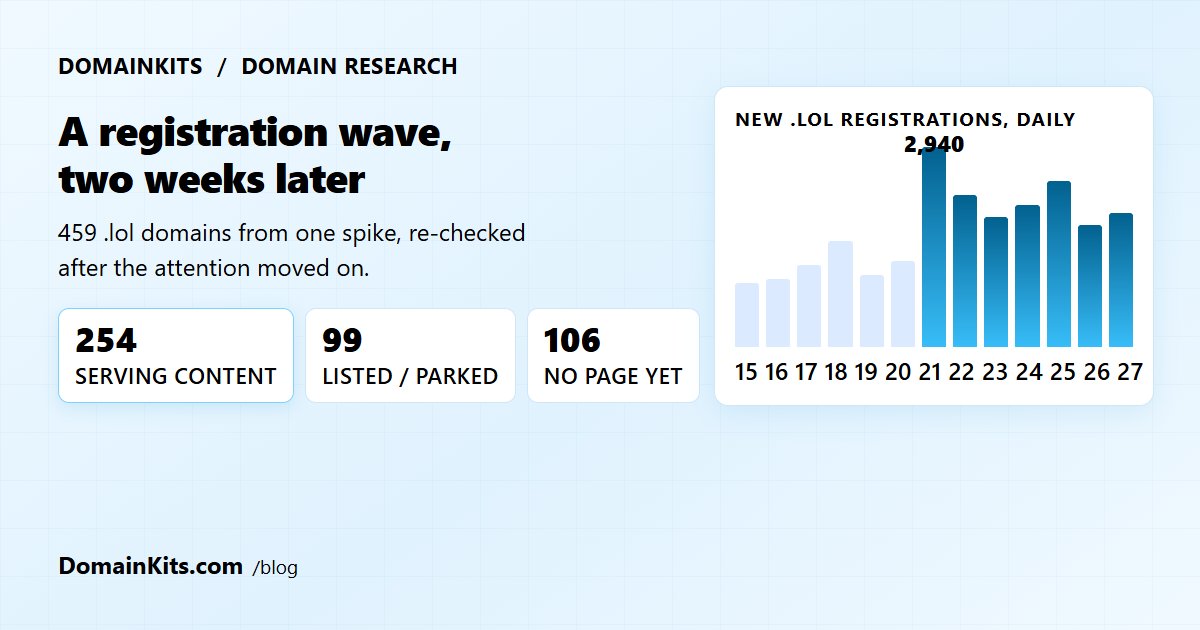
In late August 2026 that positioning got a live test. A pay-to-rank leaderboard site, outbid.lol, went viral, and .lol registrations rose sharply over the same days.
Spikes like that are easy to count and easy to misread. The number gets quoted and the story stops. So we took 459 of those newly registered domains, recorded how they were configured when they first became visible, and re-checked every one on September 3, once the attention had moved on.
The spike, and what the second curve adds
Through August 5 to 18, .lol ran near 1,200 new registrations a day. The site launched on August 19. That day brought 1,065 registrations and the next 1,270, both ordinary. The jump landed on August 21 with 2,940. Across August 21 to 27 the extension took 15,397 names.
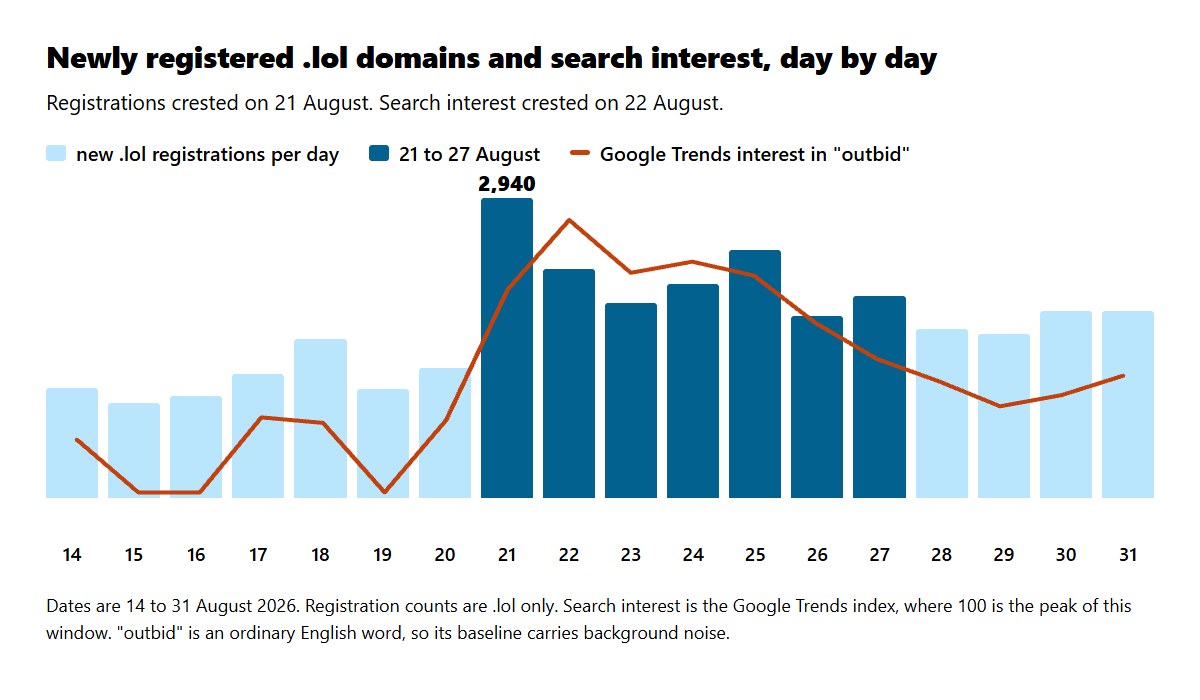
Search interest sits on a different schedule from the launch date. Worldwide interest in the term crested on August 22, a day after registrations did. Both curves lifted on August 21, and neither moved on the August 19 launch itself. The timing is consistent with registrations tracking attention rather than the announcement, though correlation across a single event is as far as this goes.
The one-day lag only appears when registration counts and search interest are plotted together.
Isolating the cohort
A daily count cannot separate a wave from the background. The same 90-day window holds bulk events larger than this one, including two batches of roughly 2,500 names each on July 31 and August 6 that relate to nothing.
So we cut by name. Within August 21 to 27 we took names containing outbid, rank, bid, bidder, bidding, leaderboard or founderboard, minus the recurring high-volume patterns .lol carries at all times, which are unrelated to this event. That gives 459 domains. The same filter across the previous fortnight returns 6 names in 14 days.
This is .lol only. Counts published elsewhere run from 190 to over 500 because they span several extensions, so they are not measuring the same thing.
What the 459 became
On September 3, thirteen days after the peak, each domain was re-checked for nameservers, A records, and whatever it returns over HTTP.
- 254 serve their own content
- 99 are listed for sale or on a parking page
- 106 return no page: no A record, an error, an empty response, or a redirect elsewhere
All three are ordinary outcomes for a newly registered domain. Two weeks on, the group serving its own content is the largest of the three.
The day a name was registered separates the three groups
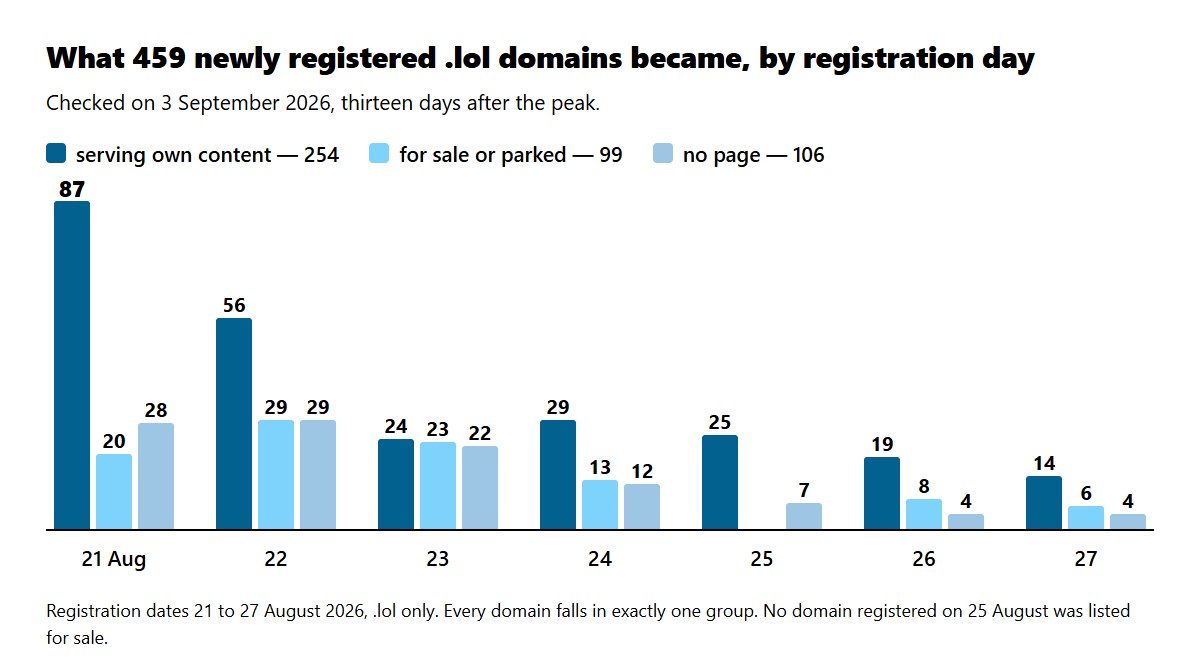
Split by registration date, the three groups do not rise and fall together.
The domains that ended up running a site are heavily front-loaded. 87 of the 254 were registered on August 21, the peak day itself, and the count falls away from there: 56, 24, 29, 25, 19 and 14. More than half of them arrived in the first two days.
The 99 that ended up listed for sale peak a day later, on August 22, and are spread more evenly across the week. The 106 with no page follow much the same shape.
The names are not what distinguishes them. Median length is 9 characters in all three groups. What differs is when they were bought.
Where they point differs too. Setting aside the 99 for-sale names and 23 with no A record, 337 remain: 291 resolve to hosting and deploy networks, 12 to parking or registrar networks, and 6 to networks fitting neither. The remaining 28 could not be matched to a network operator.
What this data cannot say
The classification above uses A records and HTTP responses rather than delegation alone: 282 of the 337 had the same nameserver provider at both observations, and 253 of those serve content. Nothing about building a site requires changing nameservers.
The limit that does bite is timing. Zone data does not appear the instant a domain is created, so what we record as the first configuration is the configuration at first visibility, and whatever an owner did before that point is invisible to us. We can count how many of these newly registered domains are doing something. We cannot date when any of them started, and any claim about day-one intent would be an artifact of the observation window rather than a finding.
What got built
Among the 254, naming is direct. These counts overlap: 137 contain rank, while 119 contain bid, including 107 with outbid. The sites make three recognizable moves.
Vertical splits keep the mechanic and narrow the audience: outbidcars.lol, outbidairlines.lol, outbidnewsletters.lol, appstorerank.lol, rankbot.lol for Telegram bots, srank.lol for Twitch. Of the built sites, 35 address an AI or startup audience, 21 apps and developers, 17 creators.
Geographic splits do it by region: outbid-eu.lol, outbidworld.lol, rankeate.lol in Spanish for Ecuador.
A meta layer sells the wave itself. 11 of the built sites are directories of the others, among them outbid-directory.lol, outbidstats.lol and outbidception.lol, which calls itself a leaderboard of leaderboards. A few change the rules instead of the audience: dailyrank.lol resets its board daily, getoutbid.lol refunds half your bid when you are outbid.
Why it landed in .lol
A leaderboard where the highest bid takes the top slot, and everyone can see what everyone paid, sits squarely in the register the word has carried since 1989. The joke is the product.
The wave did not go to .com. It followed outbid.lol into the same extension: 459 registrations in a week, with 254 serving sites two weeks after the peak. An extension created for internet humor was chosen at speed for projects built around internet humor.
This is one event, not evidence that .lol has become the default for viral projects. If later waves show the same pattern, that interpretation becomes harder to dismiss.
How to watch a wave
- Cut the cohort by name, not by date. A daily count mixes the wave with everything else an extension does, and routine bulk registrations can dwarf the event you are looking for.
- Record the configuration at first visibility. Without that first reading there is nothing to compare against, and the chance does not come back.
- Re-check after the attention leaves. Two weeks separated 254 from 99 from 106. During the spike all three looked identical.
- Classify on what the domain resolves to, then on what it serves. A record, then HTTP response. Neither alone separated the three groups here.
- State what the data cannot say. Ours cannot date the moment these owners started work, only count how many are doing it.
- Track which extension the wave chose. Look for the same preference across later waves.
All of it comes from registration records and public DNS: names, dates, registrars, nameservers, addresses, and what a web server returns to anyone who asks. Nothing about the people behind the domains was collected or needed. To follow the next wave, search the latest domain registrations, download the daily gTLD domain lists, or use change monitoring to see what moves after registration.
How the data was collected
Cohort. Selected by keyword, not by any link back to the source site. From .lol registrations dated August 21 to 27, 2026 we kept names containing outbid, rank, bid, bidder, bidding, leaderboard or founderboard, and dropped the recurring high-volume patterns .lol carries at all times. That gives 459 names. Membership is therefore inferred rather than confirmed: rank and bid are ordinary English substrings, and at least one name in the set, a European place name, matches by coincidence.
How much of it is background. The same filter over the previous fortnight returns 6 names in 14 days, so roughly 3 would be expected across this seven-day window against 459 observed. Of the 254 serving content, 226 describe the mechanic in their own page title. The 205 without a page cannot be checked individually.
Sources and timing. Registration dates, registrars and first-seen nameservers come from zone-derived registration records; nameservers, A records and HTTP responses were re-checked on September 3, 2026, thirteen days after the peak. Search interest is the Google Trends index for "outbid", worldwide, where 100 is the peak of the plotted window. Figures are .lol only. First-seen configuration reflects first visibility in zone data, which is later than the moment of registration by an unknown interval.
Get new articles by email
No account needed. At most one email a day, only when there is something new.
We use your email only to send new articles. Every email has a one-click unsubscribe link. Privacy policy