The IANA ID: How a Small Number Explains the Registrar Behind a Domain
Most gTLD domains you register, the .com, .net, .org, and the newer extensions, pass through an ICANN-accredited registrar that carries a small number you probably never saw. It is called the IANA ID. It does not cover country-code domains like .de or .uk, which their national registries manage under their own rules, but across the gTLD space, once you know what the number is, a registrar record becomes a good deal easier to read.
To understand the number, you first have to understand two organizations that are often confused for each other: IANA and ICANN.
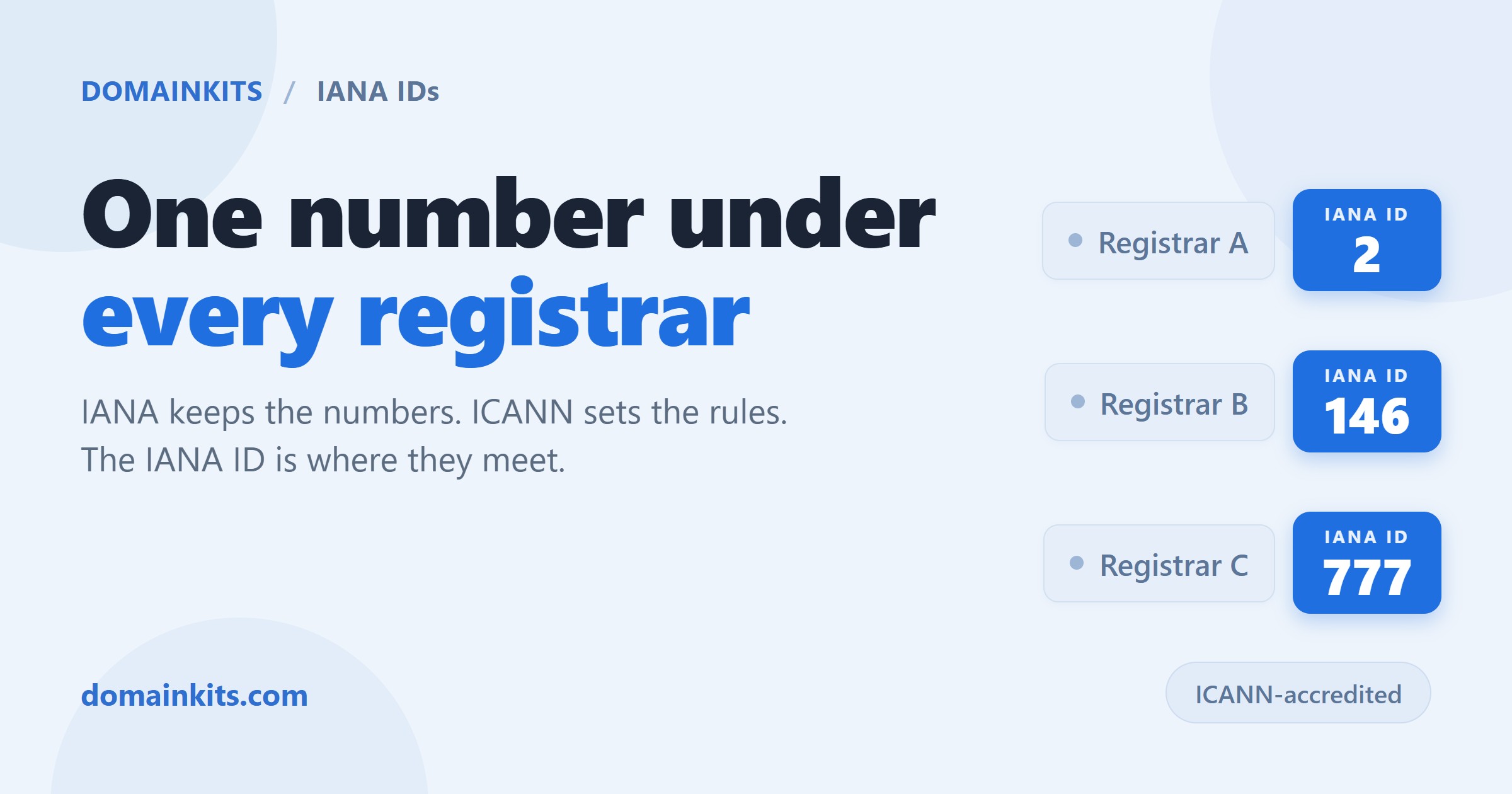
Two names, one job, split in half
The internet runs on things that must be unique. Two networks cannot claim the same address. Two registrars cannot share the same identity. Something has to hold the master list, and that job is old, older than most of the companies that depend on it.
IANA, the Internet Assigned Numbers Authority, is the keeper of those lists. It maintains the authoritative registries for the unique numbers the internet is built on: IP address blocks, protocol parameters, the root of the domain name system, and the ID numbers recorded for the companies accredited to sell domains. IANA is deliberately boring. Its job is to make sure a number means one thing and only one thing, and to keep meaning that same thing for a very long time.
ICANN, the Internet Corporation for Assigned Names and Numbers, is the newer, more public organization. It was created in 1998 to set the policy around all of this: who is allowed to become a registrar, what rules they must follow, how disputes are handled, how new extensions are approved. If IANA is the ledger, ICANN is the institution that decides what gets written into it and under what conditions.
The relationship is simplest to hold in one line. ICANN sets the rules. IANA keeps the numbers. They are closely tied rather than the same thing (the IANA functions are now managed by an ICANN affiliate), but the split is what matters: one half decides, the other half records. The place where those two halves touch, for anyone dealing with domains, is the IANA ID.
What is an IANA ID?
When a company is accredited by ICANN to sell domains, it does not just get a contract. It gets a number. That number is its IANA ID, sometimes written as the IANA registrar ID, and it is the standing identifier for that registrar in the record. The accreditation behind it can change status over time, but the number itself is not reassigned to someone else.
The numbers are small and sequential, handed out roughly in the order registrars were accredited. The early accredited registrars carry low numbers. Newer ones carry higher numbers, now well into the thousands. A single low number like 146 points to one specific accredited company and nothing else, the way a passport number points to one person.
A few things make the IANA ID useful in a way a brand name rarely is:
- It outlives the brand name, but not always the owner. Companies rename, rebrand, and get acquired, and the IANA ID underneath usually stays put, which can connect a registrar's past name to its present one. Read it the other way, though, and the same persistence cuts against you: accreditations are bought and sold, and a larger operator can pick up a batch of dormant accredited registrars, IANA IDs and all, to use for drop-catching. The number holds steady while the party actually behind it has changed. So the ID tells you which accreditation you are looking at, not who controls it today.
- It is unambiguous. Dozens of registrars use similar-sounding trade names. The IANA ID does not care what a company calls itself this year. One number, one accreditation.
- It appears in the record. When you look up a domain, the registrar of record is identified by this number. It is the machine-readable answer to the question of which registrar is responsible for this name.
Why the number matters more than the name
Here is where the small number starts to tell a story. The list of registrars is not a flat list of independent companies. It is a landscape with structure, and the IANA ID is how you see that structure.
One operator can run under more than one accreditation at once. A single IANA ID may turn out to be one interface of a larger registrar, sitting alongside other accreditations the same operator uses. Read the brand names alone and each looks like a separate company. Line up the IANA IDs and the links between them, and some of those separate names resolve into interfaces of the same operator.
Seeing that link, from one IANA ID to the registrar it may be an interface of, is the difference between a name and an explanation. It answers questions the brand name cannot:
- Drop-catching. Some operators run many accreditations for a specific reason: to compete for expiring domains at the moment they are released, using multiple registrar interfaces to improve their odds. A setup built mainly to catch dropped names behaves very differently from a retail registrar, and the pattern is easier to recognize once you can see one IANA ID flagged as a drop-catching interface.
- Accreditation status. An IANA ID is durable, but the accreditation behind it is not fixed for good. A registrar's status can be active or no longer accredited, and a number that was live before may not be now. Knowing the status changes how you read any domain still sitting under it.
None of this is exotic data. It is the public accreditation record that ICANN maintains, keyed by the IANA IDs. What is missing, most of the time, is a way to read it as structure instead of as a spreadsheet of names.
Reading it yourself
This is the gap the DomainKits Registrar Lookup is built to close. You can search it two ways: by name, if you know the brand, or by IANA ID, if you have the number from a domain record and want to know which registrar is behind it.
Type a name like GoDaddy or Namecheap and you get the accredited registrars that match, each with its own IANA ID and status. Type a number like 146 and you go straight to the single registrar it belongs to. Either way, the lookup shows the things the brand name hides: the accreditation status, whether the entity is flagged as a drop-catching service, its public contact details from the official record, and, where one exists, a note that this IANA ID might be an interface of another registrar, with a link to that one.
A single card tells you about one accreditation. The link to the registrar it may be an interface of tells you the account it appears to sit behind, and turns a wall of unfamiliar names into something you can actually follow.
The short version
IANA and ICANN are not the same organization, and they are not competitors. They are one job split in two: ICANN decides the rules, and the IANA functions keep the numbers. The IANA ID is the small, durable object where the two meet, the standing identifier for a company accredited by ICANN to sell gTLD domains.
Learn to read it and the gTLD side of the domain industry gets more legible. A brand name tells you what a registrar wants to be called. The IANA ID tells you which accreditation you are looking at, whether it is still live, and which larger registrar it may be an interface of. It does not promise who controls that accreditation today, since accreditations change hands, but it is still a lot of signal for one small number.
Start with a name or a number: look up a registrar by name or IANA ID and see the structure for yourself.
Get new articles by email
No account needed. At most one email a day, only when there is something new.
We use your email only to send new articles. Every email has a one-click unsubscribe link. Privacy policy